
Carver County Arrest Records and Court Charges
Carver County arrest records begin on the law-enforcement side. The Sheriff's Office jail roster shows people currently in custody and people released within the prior 90 days. The roster is updated every two hours and can show name, age, booking and release dates and times, custody status, bail, next court date, arresting agency, charges, and status. Those jail fields are not the same thing as the complete District Court case file.
Charges after arrest become court charge records when the prosecutor files them in Carver County District Court. The Carver County Attorney's Office, led by County Attorney Mark Metz, prosecutes adult felonies and many county-level criminal matters. Once filed, the charge appears in the criminal court case with a case number, hearings, plea, disposition, and sentence if the case reaches those stages. For custody status, use the jail roster. For the full court case, use criminal court records. For broader case types, use court records.
Arrest Records to Charges After Arrest
The arrest-to-charges pathway usually starts with a police officer, deputy, or other law-enforcement agency making an arrest or issuing a citation. Jail booking can create a custody record and a charge label before the prosecutor has completed review. Prosecutor review decides what formal charges, if any, will be filed. The filed complaint or citation then opens the court charge record in District Court.
Chaska Police is a key local agency for the courthouse city. The Chaska Police page lists the department at 301 Engler Blvd., Chaska, MN 55318, Chief Ryan Seibert, phone 952-448-4200, non-emergency 952-361-1231, and tip line 952-227-2479.
The Chaska Police Department page documents local law-enforcement contact details for the county seat.
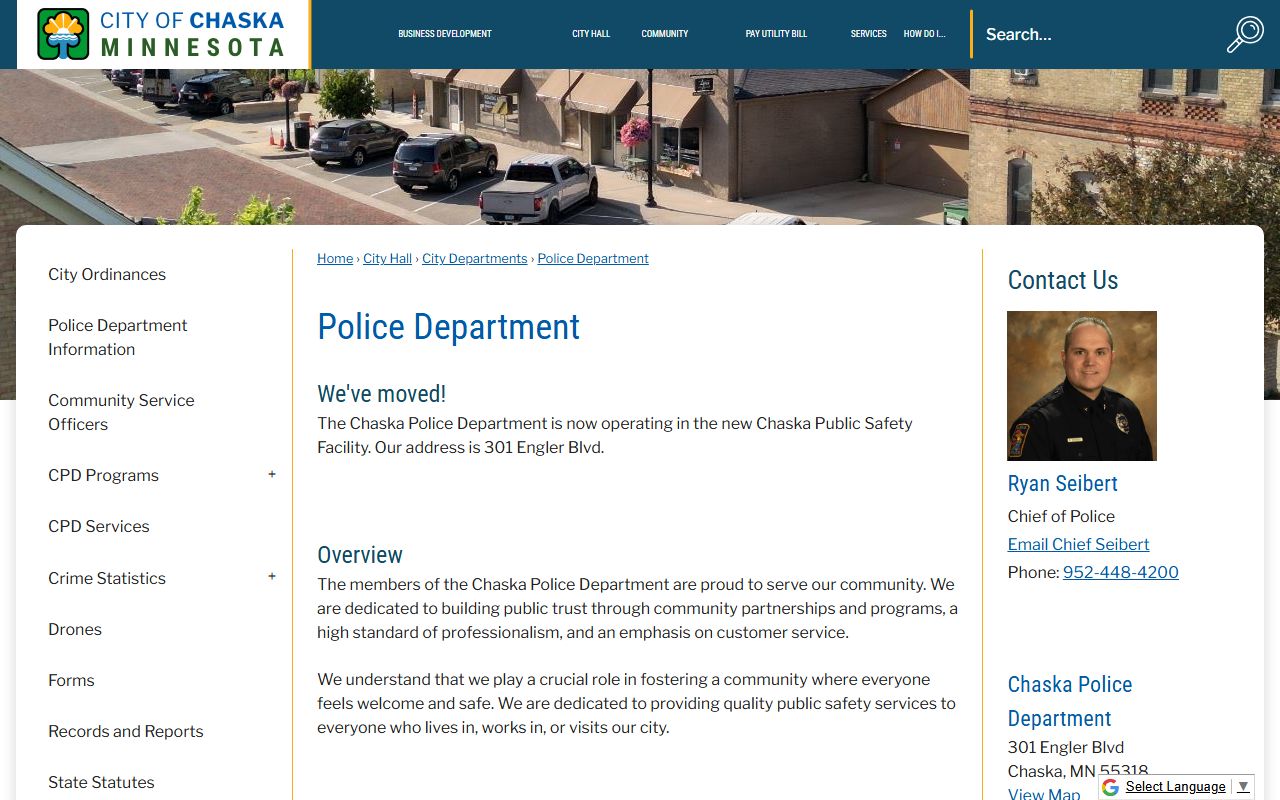
Police agency context helps explain why an arrest report, a jail booking record, and a District Court charge can exist in different systems.
How to Find Carver County Arrest Records and Charges
Start with the record type. For current or recent custody, use the official Carver County jail roster linked from the Sheriff's Office jail services pages. For formal court charges, use MCRO Case Search and narrow to Carver County and criminal case category. For a pending or non-conviction criminal matter, search by case number when available because defendant-name searches may not return the case.
- Search the Carver jail roster when the question is whether someone is in custody or was released within the last 90 days.
- Open MCRO Case Search when the question is whether formal court charges were filed.
- Use defendant name, case number, or citation number, then narrow to Carver County.
- Open the case and review charge counts, offense descriptions, severity, hearing schedule, and Register of Actions.
- Compare jail charge status with court disposition because the jail roster may show Court/Pending before the court case is complete.
- Request sheriff records from the Sheriff Records Unit when the needed record is an arrest report, incident report, 911 audio, photo, or video.
Charging Documents After an Arrest
A charge record is built from the document that starts or amends the prosecution. Minnesota Carver records can include complaints, citations, amended complaints, warrants, orders, plea entries, and dispositions. A complaint usually describes the offense allegations and legal basis. A citation can start a traffic or lower-level criminal matter. A warrant or summons can bring the defendant to court. The court file later tracks whether the charge is pending, amended, dismissed, resolved by plea, or decided at trial.
| Document or Entry | Role in the Charge Record | Where to Look |
|---|---|---|
| Complaint | Formal written charge allegations filed by the prosecutor. | MCRO case documents when public, or Court Administration copies. |
| Citation | Ticket or charging instrument, often for traffic, petty, or misdemeanor matters. | MCRO Citation Number tab, Web Payment, or District Court case file. |
| Amended complaint | Changes, adds, reduces, or clarifies charge counts. | Register of Actions and public documents if available. |
| Warrant or summons | Orders appearance, arrest, or other enforcement. | District Court case and Sheriff's warrant channels. |
| Disposition entry | Shows how a charge ended. | MCRO case details and certified copy request if official proof is needed. |
Charge Status and What It Means
Charge status can change as a case moves through District Court. A jail roster may show a charge and status before a full court disposition exists. MCRO and the Register of Actions should be checked for the court status, hearing dates, plea entries, and outcome. Some statuses require careful reading because a dismissed count can exist beside a conviction on a different count in the same case.
| Status | What It Means |
|---|---|
| Pending | The charge is filed or listed, but no final outcome has been entered. |
| Amended | The prosecutor changed the charge, count, description, severity, or statute basis. |
| Reduced | The charge moved to a lower severity or different offense as part of amendment or plea. |
| Dismissed | The charge ended without conviction on that count. |
| Convicted | The court entered a conviction after plea, verdict, or qualifying finding. |
| Probation violation | A later allegation that sentence conditions were violated, often in the same criminal case history. |
Charges vs. Convictions
Being charged is not the same as being convicted. A charge is an allegation that starts a court process. A conviction is a final court outcome based on a plea, verdict, or other qualifying finding. Carver County charge records may show dismissed, amended, or pending charges that should not be described as convictions. BCA Public Criminal History is focused on public conviction history, while MCRO shows the court case record when public.
| Charge | Conviction | |
|---|---|---|
| Stage | Filed after arrest or citation. | Entered after plea, verdict, or qualifying court finding. |
| Proof | Accusation based on probable cause and prosecutor review. | Final adjudication or plea under criminal procedure. |
| Record source | Jail roster, complaint, citation, MCRO case file. | MCRO disposition and BCA public criminal history when eligible. |
| Can change | Can be amended, reduced, added, or dismissed. | Can be appealed, corrected, sealed, expunged, or affected by later relief. |
Prosecutor and Sheriff Records Context
The County Attorney files and prosecutes court charges. The Sheriff's Office and local police agencies keep law-enforcement data connected to arrests, reports, and investigations. The Sheriff's Records Unit accepts public-data requests by phone at 952-361-1105, email at Sheriff-Records@carvercountymn.gov, mail to Carver County Sheriff's Office, ATTN: Records Unit, 606 East 4th Street, Chaska, MN 55318, and in person Monday-Friday, 8:00 a.m. to 4:30 p.m.
Sheriff records can include incident reports, 911 audio or transcripts, photos and videos, civil process records, local background checks, and records-management data. Fees can include $0.25 per printed page, variable photo or media costs, actual-cost electronic retrieval, and payment by check or money order payable to Carver County. Some data requires ID verification, and active investigative data, juvenile records, victim data, protected health information, and sealed court records can be withheld or redacted.
The Minnesota law-enforcement data statute controls many arrest and investigative-data classifications.
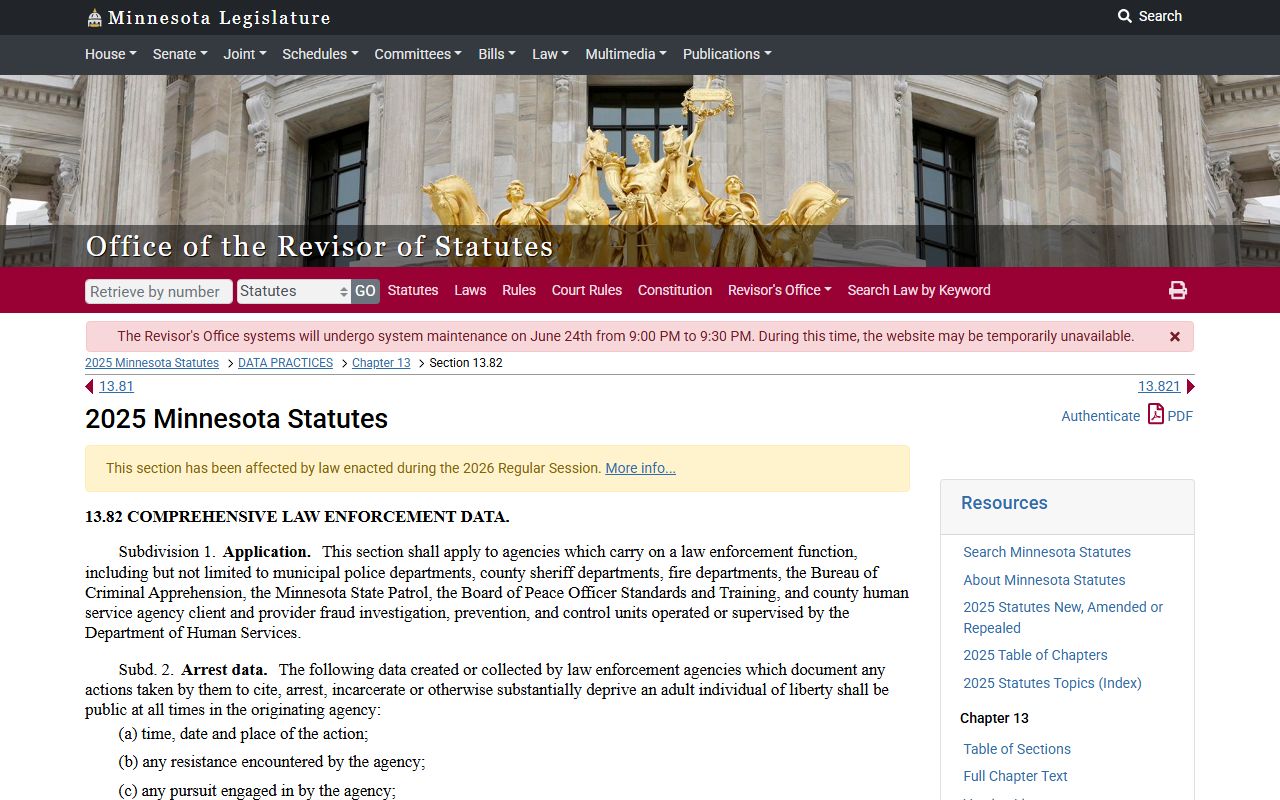
That statute is why some arrest data may be public while active investigative, victim, juvenile, medical, or protected information is not released.
Charge Codes and Severity Levels
Carver jail roster sample data showed charge examples such as fifth-degree controlled-substance possession or paraphernalia residual, possession of burglary or theft tools, domestic assault misdemeanor, DWI under influence of a controlled substance, and third-degree DWI. The active warrant listing uses offense levels such as Misdemeanor, Gross Misdemeanor, and Felony. Court files can show statute references, offense descriptions, charge counts, and later amendments when public.
One arrest can produce several separate charges. Some charges may be dismissed while another count is resolved by plea. Some traffic-related charges use 10-VB case numbers, while criminal matters use 10-CR case numbers. A court charge record should be read count by count rather than assuming the first charge label is the final outcome.
Public Defender and First Appearance
After an arrest, the first court appearance can involve bail or release conditions, appointment or application for counsel, scheduling, and next hearing dates. The Judicial Branch public defender page explains that a person should ask for a public defender as early as first appearance. The Carver County Attorney FAQ says a person charged with a misdemeanor, gross misdemeanor, or felony may qualify, applications are available from the Court Administrator's Office, and a District Court judge reviews the request.
The Minnesota Judicial Branch public defender page explains eligibility and application timing.
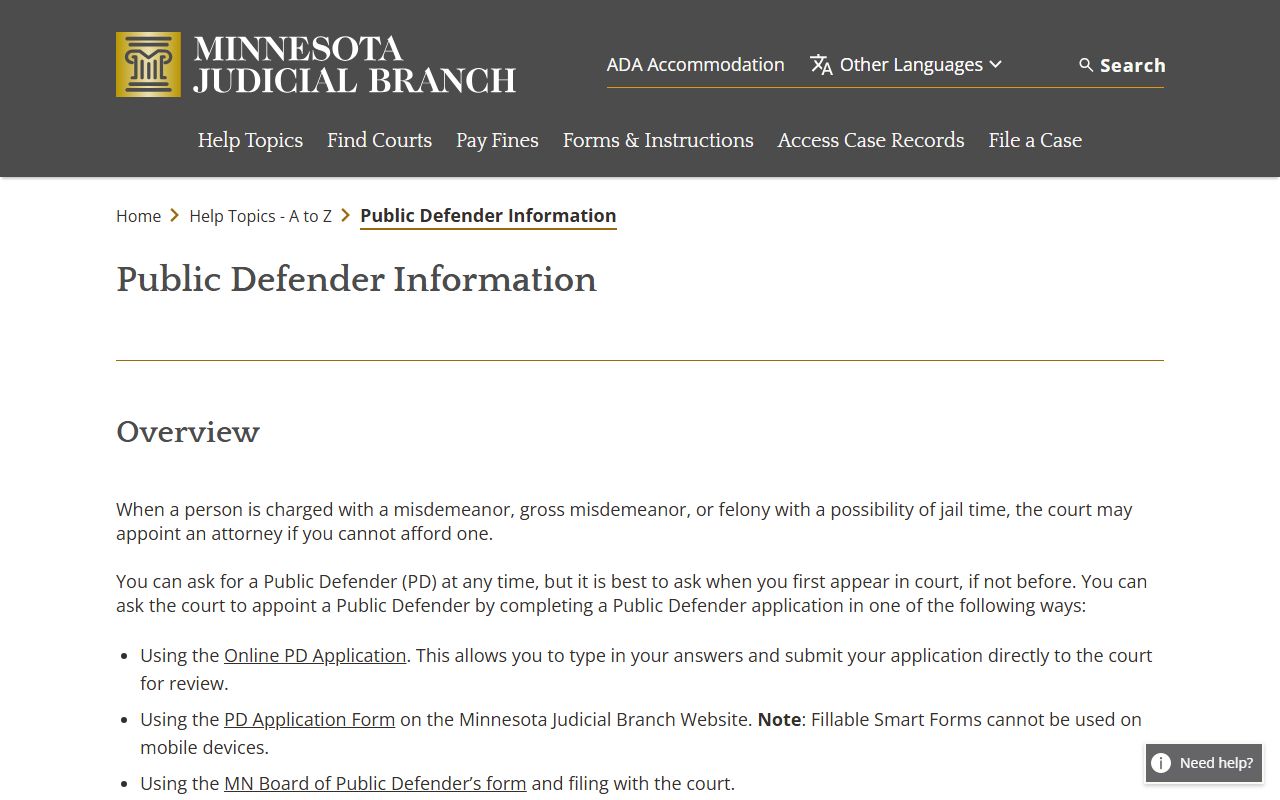
Public defender timing matters because counsel issues often appear early in the Register of Actions after charges are filed.
Sealed vs. Expunged Records
Sealed and expunged records are not ordinary public charge records. A sealed record is hidden from public access by court order, statute, or rule. An expunged criminal record is sealed or removed from public visibility under Minnesota expungement authority, including Minn. Stat. chapter 609A, Clean Slate relief, or cannabis-related relief. MCRO may not show expunged cases, and BCA CHS visibility may differ from court-record visibility.
| Sealed | Expunged | |
|---|---|---|
| Public access | Blocked or limited for the public. | Removed from public view or sealed under expungement authority. |
| Record systems | May affect court, sheriff, prosecutor, or specific documents. | May affect court records and BCA criminal-history records differently. |
| Common trigger | Court order, confidentiality rule, juvenile status, protected data, or statute. | Expungement petition, Clean Slate review, cannabis relief, or statutory process. |
| Practical impact | Requires authority to inspect. | Public searches may not return the case or charge. |
Local Arrest Records Access Notes
The City of Carver receives sheriff services rather than operating a separate full local court. The City of Carver sheriff services page links residents to Sheriff's Office resources, non-emergency contact, and city public-safety information. Regardless of which Carver County agency made or supported the arrest, formal criminal and traffic charges filed after arrest are heard in District Court, not a city court.
The City of Carver Sheriff's Office services page helps place sheriff records in local context.
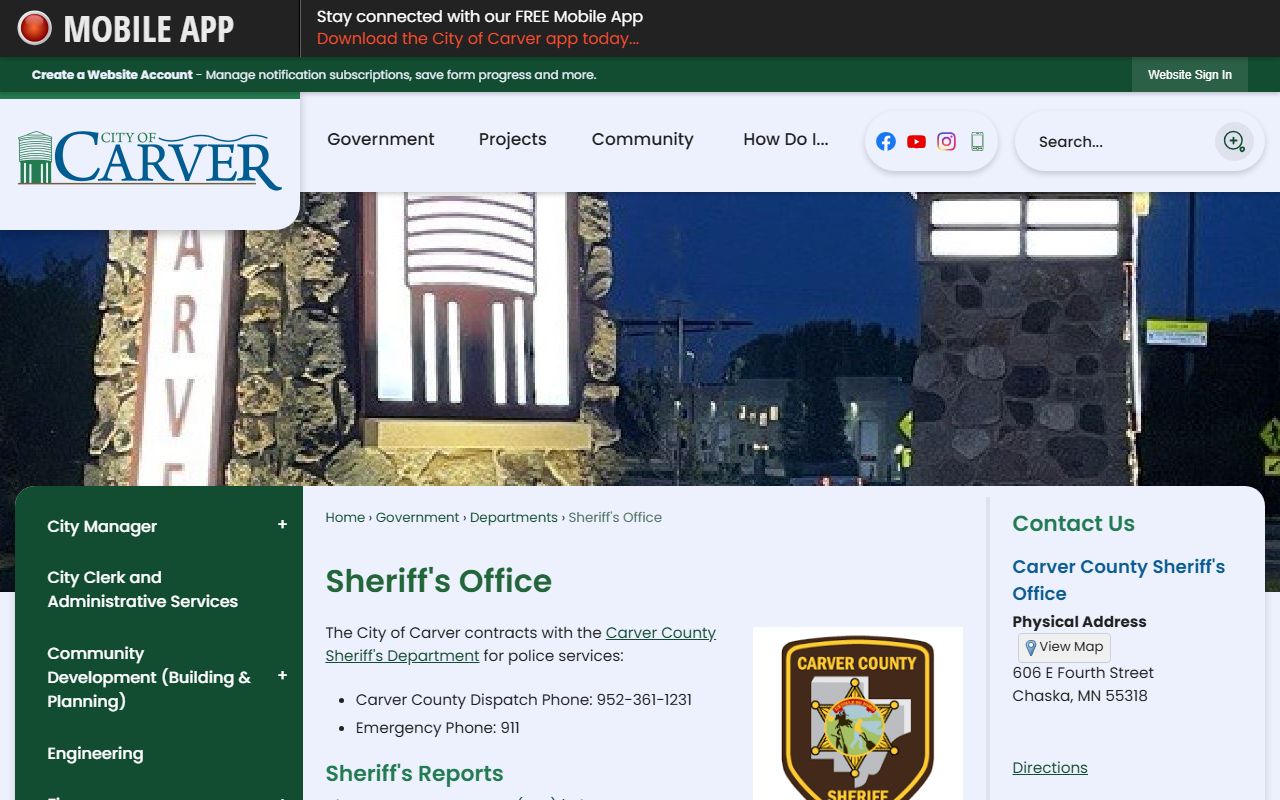
That local split is important: sheriff and police records explain the arrest, while District Court records show the formal charge and case outcome.